AI should help us solve harder problems.

Most organizations already have the data they need. They have dashboards, analytics tools, and often a few AI pilots running. What they're missing is the connective tissue between raw information and confident action. The result is familiar: analysis stalls, committees form, "let's study this further" becomes the default answer.

Decision intelligence is the discipline that closes that gap. It's not new. Military intelligence, actuarial science, and clinical decision support have operated this way for decades. What's new is that modern AI and computation make it accessible to any organization, right now.

What is decision intelligence

Decision intelligence connects data, analysis, and human judgment into a structured process that produces confident, evidence-based decisions. Not predictions. Not visualizations. Decisions, with supporting evidence, confidence scores, and clear recommendations.

It works by making the invisible visible: what data actually matters, what's noise, which controls should govern the decision, and how confident you should be in the outcome across a range of scenarios.

The decisions this actually applies to

Decision intelligence isn't abstract. It's the discipline you reach for when the decision is high-stakes, the data is messy, and "let's study this further" is starting to become the answer. A few concrete examples:

Different sectors, same shape: a defensible answer under real uncertainty.

ARGUS

ARGUS is the Northern Light Analytics decision intelligence platform. It takes disparate data from multiple sources and turns it into evidence-based recommendations, with explicit ranges and confidence scores instead of point estimates.

The five-stage pipeline

01

Collect

Structured ingestion from your systems and from open sources. Internal data (policy documents, operational records, market intelligence) combined with public data (regulatory filings, macroeconomic indicators, event streams) that AI can now turn into usable structured signal.

02

Filter

Signal separated from noise. The factors that actually influence the decision, and only those.

03

Controls

Risk thresholds, compliance requirements, and strategic priorities mapped explicitly.

04

Weigh

Monte Carlo simulation across thousands of scenarios. A probability distribution, not a single guess.

05

Decide

A clear recommendation with a confidence score and full transparency into how it was reached.

One worked example

The screenshot below shows a policy trade-off analysis. The same structure applies to supply-chain exposure, market entry, capital allocation, and investment choices. ARGUS is domain-agnostic by design.
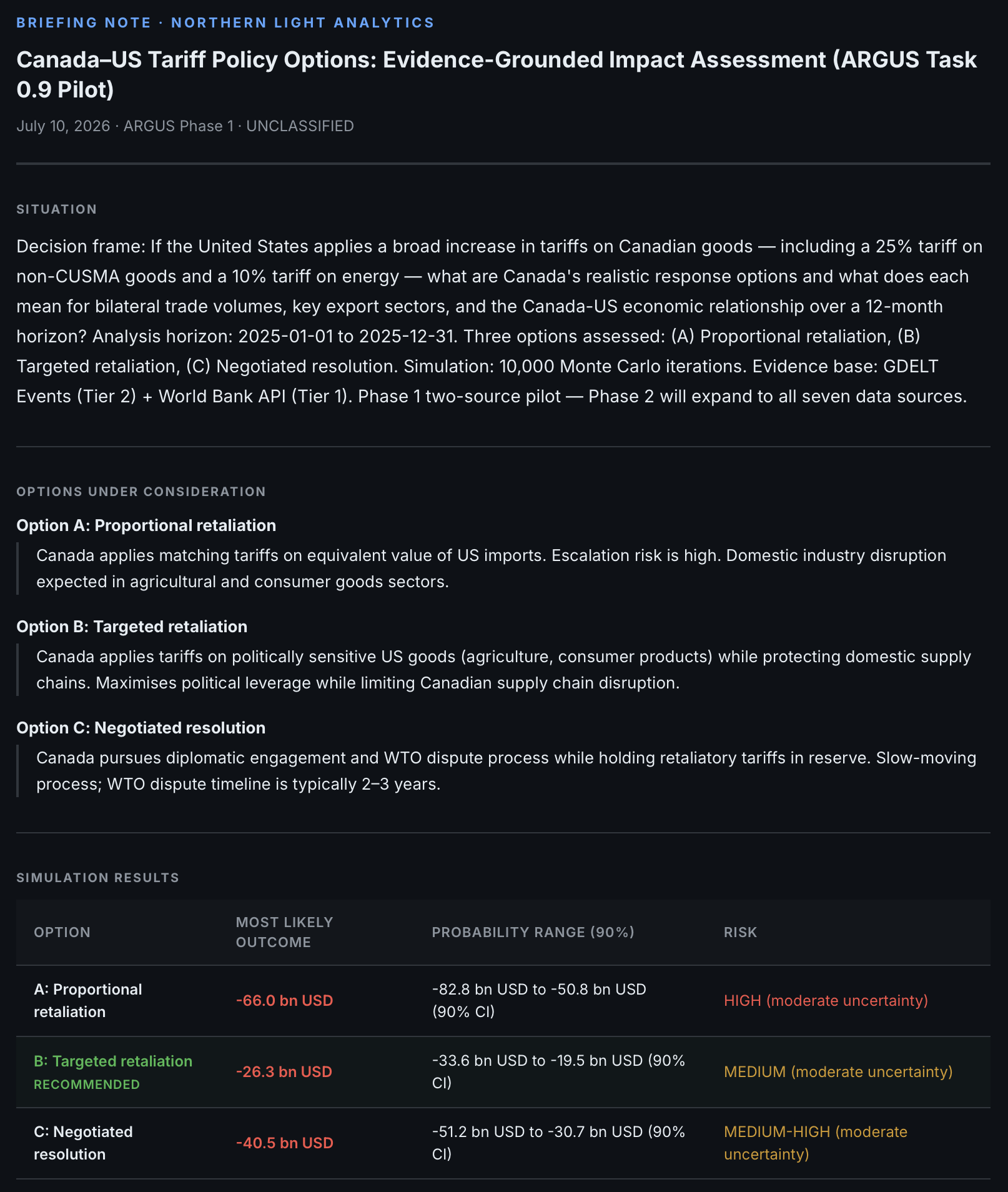
ARGUS briefing note comparing three policy options with 90% confidence intervals and risk ratings.
Briefing view. Each option carries a mean impact, a 90% confidence range, and a risk rating.

ARGUS is domain-agnostic

ARGUS was designed to work wherever high-stakes decisions meet incomplete information:

The decision domain changes. The need for structured, evidence-based analysis doesn't.

Download the ARGUS Decision Brief

A short overview of how ARGUS works, what an engagement looks like, and how it applies to your challenges.

Download the brief (PDF) →